For the third time in this book, Paul tells the story of the Damascus road — and this version, before the one audience in this whole trial actually qualified to judge it, is the most complete of all three. A Roman governor shouts that he has lost his mind; a Jewish king, for one unguarded moment, comes closer to conversion than anyone else in the entire book of Acts.
A study in Acts 26 · Arthur Baldwin · StandUp4Jesus.Org · 15 min read
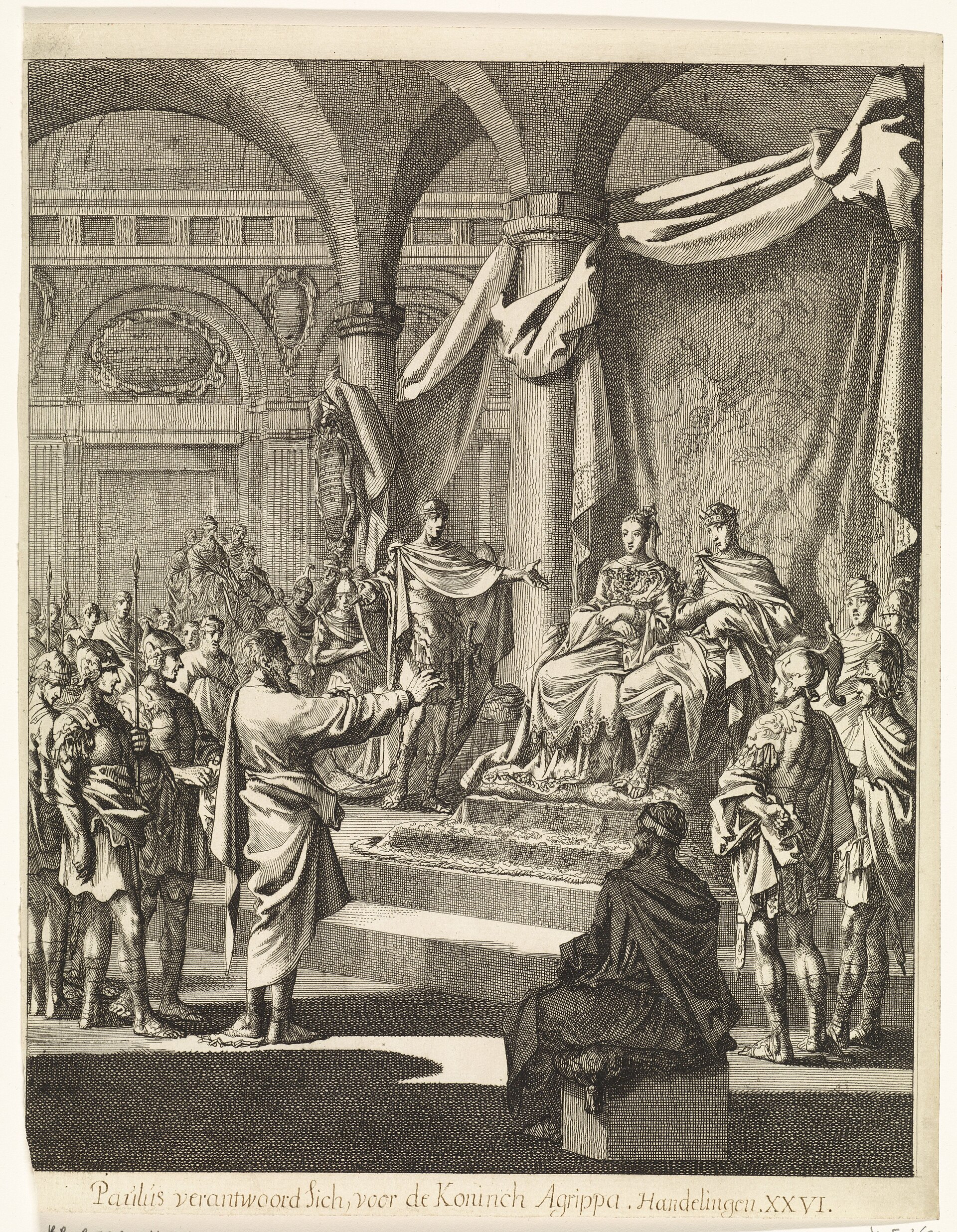
After The Most Straitest Sect Of Our Religion
“Then Agrippa said unto Paul, Thou art permitted to speak for thyself. Then Paul stretched forth the hand, and answered for himself: I think myself happy, king Agrippa, because I shall answer for myself this day before thee touching all the things whereof I am accused of the Jews.”
Acts 26:1-2
“King Agrippa now gave Paul liberty to speak for himself. The apostle was not disconcerted by the brilliant display or the high rank of his audience; for he knew of how little worth are worldly wealth and position. Earthly pomp and power could not for a moment daunt his courage or rob him of his self-control.”
Ellen G. White · The Acts of the Apostles, p. 435
Of everyone in this glittering, staged assembly — a king, a governor, soldiers in ceremonial armor — the one prisoner in chains is, by this study’s own source’s account, the single most composed person in the room.
“Especially because I know thee to be expert in all customs and questions which are among the Jews: wherefore I beseech thee to hear me patiently. My manner of life from my youth, which was at the first among mine own nation at Jerusalem, know all the Jews.”
Acts 26:3-4
Unlike every previous hearing in this book, Paul is finally addressing someone with genuine expertise in the actual subject at hand — not a Roman official guessing at “questions of their law,” but a king who, as this chapter’s own final verdict will confirm, actually understands what is being argued.
“Which knew me from the beginning, if they would testify, that after the most straitest sect of our religion I lived a Pharisee. And now I stand and am judged for the hope of the promise made of God unto our fathers.”
Acts 26:5-6
“Unto which promise our twelve tribes, instantly serving God day and night, hope to come. For which hope’s sake, king Agrippa, I am accused of the Jews. Why should it be thought a thing incredible with you, that God should raise the dead?”
Acts 26:7-8
Paul frames the entire case, before a word of his own testimony is even given, as a dispute purely about the resurrection — the very same hope the twelve tribes are still praying toward, now supposedly a crime because he claims it has already, in one specific case, come true.
“Which thing I also did in Jerusalem: and many of the saints did I shut up in prison, having received authority from the chief priests; and when they were put to death, I gave my voice against them. And I punished them oft in every synagogue, and compelled them to blaspheme; and being exceedingly mad against them, I persecuted them even unto strange cities.”
Acts 26:10-11
“I gave my voice against them” is a detail Paul’s own earlier retellings, in chapters 9 and 22, never spelled out quite this plainly — a direct admission that he did not merely watch believers condemned to death but actively cast a vote for it, presumably as a young member of the Sanhedrin itself.
It Is Hard For Thee To Kick Against The Pricks
“Whereupon as I went to Damascus with authority and commission from the chief priests, At midday, O king, I saw in the way a light from heaven, above the brightness of the sun, shining round about me and them which journeyed with me.”
Acts 26:12-13
“Above the brightness of the sun, at midday” is the most precise description this book gives anywhere of the vision’s own sheer intensity — not a dim flash easily explained away, but a light bright enough to outshine the desert sun itself at noon.
“And when we were all fallen to the earth, I heard a voice speaking unto me, and saying in the Hebrew tongue, Saul, Saul, why persecutest thou me? it is hard for thee to kick against the pricks.”
Acts 26:14
“Kick against the pricks” is a farming image — an ox straining uselessly against the sharp goad meant to guide it — found nowhere in either of this book’s two earlier retellings of this exact scene. Only here, before an audience Paul knows will actually catch a rustic Greek idiom, does this particular detail of Christ’s own words finally surface.
“And I said, Who art thou, Lord? And he said, I am Jesus whom thou persecutest. But rise, and stand upon thy feet: for I have appeared unto thee for this purpose, to make thee a minister and a witness both of these things which thou hast seen, and of those things in the which I will appear unto thee.”
Acts 26:15-16
“Delivering thee from the people, and from the Gentiles, unto whom now I send thee, To open their eyes, and to turn them from darkness to light, and from the power of Satan unto God, that they may receive forgiveness of sins, and inheritance among them which are sanctified by faith that is in me.”
Acts 26:17-18
This is the fullest single statement of Paul’s own commission found anywhere in this book — eyes opened, darkness to light, Satan’s power to God’s, sins forgiven, an inheritance among the sanctified, all compressed into two verses that read almost like a job description handed down directly from the risen Christ Himself.
I Was Not Disobedient Unto The Heavenly Vision
“Whereupon, O king Agrippa, I was not disobedient unto the heavenly vision: But shewed first unto them of Damascus, and at Jerusalem, and throughout all the coasts of Judæa, and then to the Gentiles, that they should repent and turn to God, and do works meet for repentance.”
Acts 26:19-20
“The Voice had bidden him proclaim the gospel of a risen Saviour, and how could he disobey? In Damascus, in Jerusalem, throughout all Judea, and in the regions afar off, he had borne witness of Jesus the Crucified.”
Ellen G. White · The Acts of the Apostles, p. 436
“Not disobedient” is a modest way of summarizing everything this entire study has documented since chapter 9 — three missionary journeys, riots, shipwrecks still to come, prison after prison — compressed by Paul himself into a single understated negative.
“For these causes the Jews caught me in the temple, and went about to kill me. Having therefore obtained help of God, I continue unto this day, witnessing both to small and great, saying none other things than those which the prophets and Moses did say should come.”
Acts 26:21-22
“That Christ should suffer, and that he should be the first that should rise from the dead, and should shew light unto the people, and to the Gentiles.”
Acts 26:23
Every claim Paul makes he grounds explicitly in “the prophets and Moses,” never in private revelation alone — the same move he made before the Athenian philosophers and the Berean synagogue alike, insisting his gospel is not a new invention but the fulfillment of a record his own accusers already claim to honor.
Almost Thou Persuadest Me To Be A Christian
“And as he thus spake for himself, Festus said with a loud voice, Paul, thou art beside thyself; much learning doth make thee mad.”
Acts 26:24
“The whole company had listened spellbound to Paul’s account of his wonderful experiences. … None who heard him could doubt his sincerity. But in the full tide of his persuasive eloquence he was interrupted by Festus.”
Ellen G. White · The Acts of the Apostles, p. 437
Festus’s outburst is, oddly enough, a kind of backhanded compliment — a Roman governor who cannot follow Paul’s own scriptural argument, but who is visibly moved enough by its sheer conviction that “madness” is the only explanation he can reach for.
“But he said, I am not mad, most noble Festus; but speak forth the words of truth and soberness. For the king knoweth of these things, before whom also I speak freely: for I am persuaded that none of these things are hidden from him; for this thing was not done in a corner.”
Acts 26:25-26
“Not done in a corner” is a striking claim — Christ’s death, resurrection, and the whole subsequent spread of the gospel happened in full public view, verifiable events rather than secret revelations only Paul himself can vouch for, and he appeals to Agrippa’s own certain knowledge of the record as his proof.
“King Agrippa, believest thou the prophets? I know that thou believest. Then Agrippa said unto Paul, Almost thou persuadest me to be a Christian.”
Acts 26:27-28
“Deeply affected, Agrippa for the moment lost sight of his surroundings and the dignity of his position. Conscious only of the truths which he had heard, seeing only the humble prisoner standing before him as God’s ambassador, he answered involuntarily, ‘Almost thou persuadest me to be a Christian.’”
Ellen G. White · The Acts of the Apostles, p. 438
“Involuntarily” is the key word in this study’s own source — not a calculated diplomatic reply, but words that escape a king’s own guard for one honest, unrehearsed moment, before all the pomp of the earlier procession reasserts itself.
“And Paul said, I would to God, that not only thou, but also all that hear me this day, were both almost, and altogether such as I am, except these bonds.”
Acts 26:29
“Festus, Agrippa, and Bernice might in justice have worn the fetters that bound the apostle. All were guilty of grievous crimes. … One, at least, had been almost persuaded to accept the grace and pardon offered. But Agrippa put aside the proffered mercy, refusing to accept the cross of a crucified Redeemer.”
Ellen G. White · The Acts of the Apostles, p. 438
Paul’s own reply, raising his chained hands, quietly inverts the entire room’s assumptions about who actually holds the advantage here — wishing every free, powerful person listening could trade places with the prisoner in everything except the actual chains.
“And when they were gone aside, they talked between themselves, saying, This man doeth nothing worthy of death or of bonds. Then said Agrippa unto Festus, This man might have been set at liberty, if he had not appealed unto Cæsar.”
Acts 26:31-32
This is the book’s own final verdict on the whole long legal saga, delivered privately by the one man in it best qualified to render it: completely innocent, and free, if not for a decision Paul made for entirely different reasons than escaping this particular charge. Rome itself is where he was always going, appeal or no appeal — the destination this study’s own twenty-third chapter already had Christ Himself name aloud.
