A single night vision at a port city redirects the entire future of Christianity toward Europe. Along the way, this chapter also gives four very different pictures of what it looks like for a heart to open to the gospel — a devout businesswoman, a young man in training, an exploited slave girl, and a terrified jailer at the point of his own sword.
A study in Acts 16 · Arthur Baldwin · StandUp4Jesus.Org · 22 min read
For They Knew That His Father Was A Greek
“Then came he to Derbe and Lystra: and, behold, a certain disciple was there, named Timotheus, the son of a certain woman, which was a Jewess, and believed; but his father was a Greek: Which was well reported of by the brethren that were at Lystra and Iconium.”
Acts 16:1-2
“Timothy’s father was a Greek and his mother a Jewess. From a child he had known the Scriptures. The piety that he saw in his home life was sound and sensible. The faith of his mother and his grandmother in the sacred oracles was to him a constant reminder of the blessing in doing God’s will. The word of God was the rule by which these two godly women had guided Timothy.”
Ellen G. White · The Acts of the Apostles, p. 203
This is Timothy’s third appearance in this study — first as a bystander witnessing Paul’s stoning, now as a young man whose own upbringing, in two women’s steady faithfulness rather than any dramatic conversion story, has quietly prepared him for exactly this moment.
“Paul saw that Timothy was faithful, steadfast, and true, and he chose him as a companion in labor and travel. … Timothy was a mere youth when he was chosen by God to be a teacher, but his principles had been so established by his early education that he was fitted to take his place as Paul’s helper.”
Ellen G. White · The Acts of the Apostles, p. 203
“Him would Paul have to go forth with him; and took and circumcised him because of the Jews which were in those quarters: for they knew all that his father was a Greek.”
Acts 16:3
“As a precautionary measure, Paul wisely advised Timothy to be circumcised—not that God required it, but in order to remove from the minds of the Jews that which might be an objection to Timothy’s ministration. … Yet while he conceded this much to Jewish prejudice, he believed and taught circumcision or uncircumcision to be nothing and the gospel of Christ everything.”
Ellen G. White · The Acts of the Apostles, p. 204
Read next to last chapter’s own hard-won letter — formally declaring that Gentile believers need not be circumcised — this looks at first like a contradiction. It is not. Paul circumcises Timothy as a purely practical courtesy toward Jewish sensibilities, not as any admission that salvation requires it; the same man who refused to let Titus be circumcised under compulsion (Galatians 2:3) freely has Timothy circumcised where nothing but usefulness for the mission is at stake.
“And as they went through the cities, they delivered them the decrees for to keep, that were ordained of the apostles and elders which were at Jerusalem. And so were the churches established in the faith, and increased in number daily.”
Acts 16:4-5
The Jerusalem letter from chapter 15 is not simply filed away; it travels, city by city, doing exactly the reassuring work it was written to do.
The Spirit Suffered Them Not
“Now when they had gone throughout Phrygia and the region of Galatia, and were forbidden of the Holy Ghost to preach the word in Asia, After they were come to Mysia, they assayed to go into Bithynia: but the Spirit suffered them not. And they passing by Mysia came down to Troas.”
Acts 16:6-8
Two doors close in quick succession, without explanation given to the missionaries themselves — Asia, then Bithynia, both directions any reasonable itinerary would have tried next. Guidance here comes first as restriction, closed roads rather than an open one, and Paul and his companions keep walking anyway, trusting a “no” they cannot yet see the reason for.
“And a vision appeared to Paul in the night; There stood a man of Macedonia, and prayed him, saying, Come over into Macedonia, and help us. And after he had seen the vision, immediately we endeavoured to go into Macedonia, assuredly gathering that the Lord had called us for to preach the gospel unto them.”
Acts 16:9-10
“The time had come for the gospel to be proclaimed beyond the confines of Asia Minor. The way was preparing for Paul and his fellow workers to cross over into Europe. At Troas, on the borders of the Mediterranean Sea, ‘a vision appeared to Paul in the night: There stood a man of Macedonia, and prayed him, saying, Come over into Macedonia, and help us.’”
Ellen G. White · The Acts of the Apostles, p. 211
Verse 10 also marks a quiet change in the text itself, easy to miss — “we endeavoured,” not “they.” This is the moment Luke, the book’s own author, joins the traveling company in person, and his narration switches from third person to first without any announcement, simply because he was there from here on.
Whose Heart The Lord Opened
“Therefore loosing from Troas, we came with a straight course to Samothracia, and the next day to Neapolis; And from thence to Philippi, which is the chief city of that part of Macedonia, and a colony: and we were in that city abiding certain days.”
Acts 16:11-12
“And on the sabbath we went out of the city by a river side, where prayer was wont to be made; and we sat down, and spake unto the women which resorted thither. And a certain woman named Lydia, a seller of purple, of the city of Thyatira, which worshipped God, heard us: whose heart the Lord opened, that she attended unto the things which were spoken of Paul.”
Acts 16:13-14
“On the Sabbath,” Luke continues, “we went out of the city by a riverside, where prayer was wont to be made; and we sat down, and spake unto the women which resorted thither. And a certain woman named Lydia, a seller of purple, of the city of Thyatira, which worshiped God, heard us: whose heart the Lord opened.” Lydia received the truth gladly. She and her household were converted and baptized, and she entreated the apostles to make her house their home.”
Ellen G. White · The Acts of the Apostles, p. 212
Philippi, a Roman colony, apparently has no synagogue — not even ten Jewish men to form one, the traditional minimum — so the little company of God-fearing women simply meets outdoors by the river instead. The whole European mission recorded in this book begins there, at an informal riverside prayer meeting, with a successful businesswoman from Asia Minor as its very first convert.
“And when she was baptized, and her household, she besought us, saying, If ye have judged me to be faithful to the Lord, come into my house, and abide there. And she constrained us.”
Acts 16:15
Her own logic is worth noticing — not “please stay with me” but “if you have judged me faithful, then stay,” treating the missionaries’ hospitality toward her as the natural, almost obligatory consequence of their own verdict about her sincerity.
Being Grieved
“And it came to pass, as we went to prayer, a certain damsel possessed with a spirit of divination met us, which brought her masters much gain by soothsaying: The same followed Paul and us, and cried, saying, These men are the servants of the most high God, which shew unto us the way of salvation. And this did she many days.”
Acts 16:16-18
“This woman was a special agent of Satan and had brought to her masters much gain by soothsaying. … Satan knew that his kingdom was being invaded, and he resorted to this means of opposing the work of God, hoping to mingle his sophistry with the truths taught by those who were proclaiming the gospel message. The words of recommendation uttered by this woman were an injury to the cause of truth, distracting the minds of the people from the teachings of the apostles and bringing disrepute upon the gospel, and by them many were led to believe that the men who spoke with the Spirit and power of God were actuated by the same spirit as this emissary of Satan.”
Ellen G. White · The Acts of the Apostles, p. 212
Every word the girl shouts is, strictly speaking, true — these men really are servants of the Most High God, really do show the way of salvation. The danger is not in the content but in the source: true words from an evil spirit still work to blur, in the public’s mind, exactly the line between God’s power and every other kind that this whole mission exists to draw clearly.
“But Paul, being grieved, turned and said to the spirit, I command thee in the name of Jesus Christ to come out of her. And he came out the same hour.”
Acts 16:18
“Being grieved” is the telling phrase — not annoyed at the distraction, but genuinely troubled on the girl’s own behalf, for an exploited person whose voice has been taken over for someone else’s profit. The deliverance costs Paul nothing to perform and everything to the men who owned her.
At Midnight Paul And Silas Prayed
“And when her masters saw that the hope of their gains was gone, they caught Paul and Silas, and drew them into the marketplace unto the rulers, And brought them to the magistrates, saying, These men, being Jews, do exceedingly trouble our city, And teach customs, which are not lawful for us to receive, neither to observe, being Romans.”
Acts 16:19-21
The actual grievance — lost income — never gets spoken aloud. It is dressed up instead as civic and ethnic outrage, an old pattern of turning a private financial injury into a public charge that will actually move a crowd.
“And the multitude rose up together against them: and the magistrates rent off their clothes, and commanded to beat them. And when they had laid many stripes upon them, they cast them into prison, charging the jailor to keep them safely: Who, having received such a charge, thrust them into the inner prison, and made their feet fast in the stocks.”
Acts 16:22-24
“The apostles suffered extreme torture because of the painful position in which they were left, but they did not murmur. Instead, in the utter darkness and desolation of the dungeon, they encouraged each other by words of prayer and sang praises to God because they were found worthy to suffer shame for His sake.”
Ellen G. White · The Acts of the Apostles, p. 213
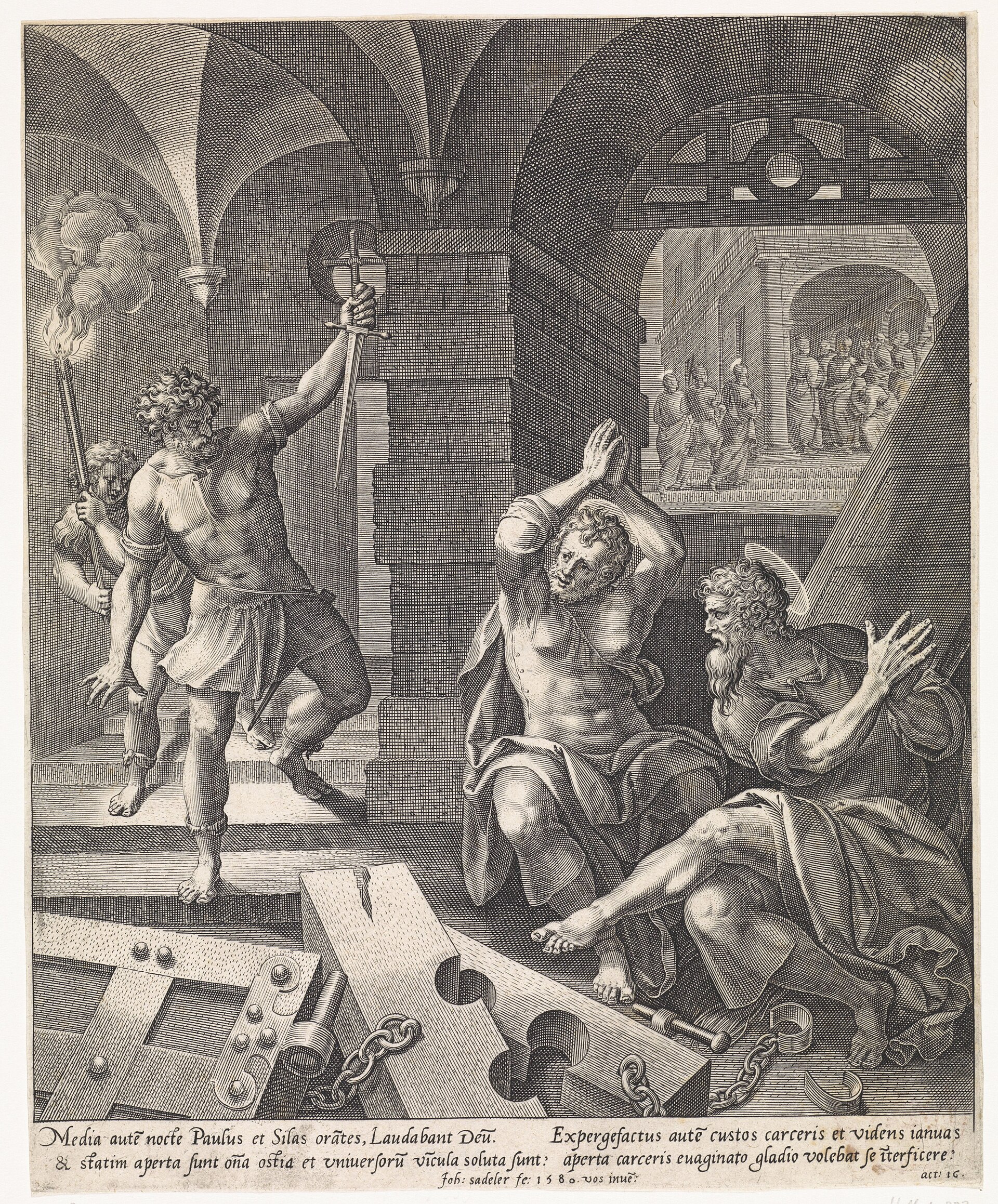
“And at midnight Paul and Silas prayed, and sang praises unto God: and the prisoners heard them. And suddenly there was a great earthquake, so that the foundations of the prison were shaken: and immediately all the doors were opened, and every one’s bands were loosed.”
Acts 16:25-26
“With astonishment the other prisoners heard the sound of prayer and singing issuing from the inner prison. They had been accustomed to hear shrieks and moans, cursing and swearing, breaking the silence of the night; but never before had they heard words of prayer and praise ascending from that gloomy cell.”
Ellen G. White · The Acts of the Apostles, p. 214
Every other prisoner in that building becomes, without asking to, a witness. The earthquake convinces no one that a proper explanation could not later have talked away; the singing at midnight, from two bleeding men in stocks, is the harder thing to explain.
“And the keeper of the prison awaking out of his sleep, and seeing the prison doors open, he drew out his sword, and would have killed himself, supposing that the prisoners had been fled. But Paul cried with a loud voice, saying, Do thyself no harm: for we are all here.”
Acts 16:27-28
“The severity with which the jailer had treated the apostles had not aroused their resentment. Paul and Silas had the spirit of Christ, not the spirit of revenge. Their hearts, filled with the love of the Saviour, had no room for malice against their persecutors.”
Ellen G. White · The Acts of the Apostles, p. 216
A man who personally drove nails into their feet a few hours earlier is, by that same night, the person Paul goes out of his way to save. Free of the stocks and the doors standing open, escape is the one thing on nobody’s mind in that cell.
“Then he called for a light, and sprang in, and came trembling, and fell down before Paul and Silas, And brought them out, and said, Sirs, what must I do to be saved? And they said, Believe on the Lord Jesus Christ, and thou shalt be saved, and thy house.”
Acts 16:29-31
“He saw in their countenances the light of heaven; he knew that God had interposed in a miraculous manner to save their lives; and with peculiar force the words of the spirit-possessed woman came to his mind: ‘These men are the servants of the most high God, which show unto us the way of salvation.’”
Ellen G. White · The Acts of the Apostles, p. 216
The exact sentence the demon-possessed slave girl once shouted through the streets, meant by Satan to muddy the apostles’ message, is the very sentence that surfaces in the jailer’s own mind at the moment he is finally ready to believe it. What was designed as a corruption becomes, in God’s hands and this man’s memory, the seed of his conversion.
“And he took them the same hour of the night, and washed their stripes; and was baptized, he and all his, straightway. And when he had brought them into his house, he set meat before them, and rejoiced, believing in God with all his house.”
Acts 16:33-34
The washing runs both directions in that single hour — the jailer washing the prisoners’ own wounds, then the prisoners’ God washing the jailer clean in baptism. Rejoicing, not relief, is the word Scripture uses for a household that an hour earlier had been braced for death.
Let Them Come Themselves And Fetch Us Out
“And when it was day, the magistrates sent the serjeants, saying, Let those men go. And the keeper of the prison told this saying to Paul, The magistrates have sent to let you go: now therefore depart, and go in peace.”
Acts 16:35-36
“But Paul said unto them, They have beaten us openly uncondemned, being Romans, and have cast us into prison; and now do they thrust us out privily? nay verily; but let them come themselves and fetch us out.”
Acts 16:37
“The apostles were Roman citizens, and it was unlawful to scourge a Roman, save for the most flagrant crime, or to deprive him of his liberty without a fair trial. Paul and Silas had been publicly imprisoned, and they now refused to be privately released without the proper explanation on the part of the magistrates.”
Ellen G. White · The Acts of the Apostles, p. 217
This is not personal pride but something closer to protection — a public, formal acknowledgment of the wrong done shields the still-fragile Philippian church from being quietly written off tomorrow as a group of troublemakers who slipped out a back door.
“And the serjeants told these words unto the magistrates: and they feared, when they heard that they were Romans. And they came and besought them, and brought them out, and desired them to depart out of the city.”
Acts 16:38-39
The same magistrates who tore off their clothes and ordered them beaten in public are now the ones personally begging them to leave quietly — the reversal complete, though never once acknowledged as an apology for the actual wrong, only fear of the actual consequences.
“And they went out of the prison, and entered into the house of Lydia: and when they had seen the brethren, they comforted them, and departed.”
Acts 16:40
The chapter’s very last stop is the same house where it effectively began. Between the riverside meeting and this closing scene at Lydia’s door, a slave girl has been freed, a jailer’s whole household has been baptized, and a church now exists in Philippi that Paul will later write to as the one that gave him more joy than any other he planted.
