A young man falls three stories to his death during an overlong midnight sermon and is raised up alive again — and that is not even the most emotionally weighty scene in this chapter. What follows is the single longest speech from Paul’s own mouth recorded anywhere in this book, delivered to men he loves and will never see again, on a beach at Miletus.
A study in Acts 20 · Arthur Baldwin · StandUp4Jesus.Org · 20 min read
Trouble Not Yourselves; For His Life Is In Him
“And after the uproar was ceased, Paul called unto him the disciples, and embraced them, and departed for to go into Macedonia. And when he had gone over those parts, and had given them much exhortation, he came into Greece, And there abode three months.”
Acts 20:1-3
“The success attending the preaching of the gospel aroused the anger of the Jews anew. … His emphatic statement, ‘There is neither Greek nor Jew, circumcision nor uncircumcision’ (Colossians 3:11), was regarded by his enemies as daring blasphemy, and they determined that his voice should be silenced.”
Ellen G. White · The Acts of the Apostles, p. 390
Three months in Greece, almost certainly including a return to the Corinth where Paul once doubted the work was even worth the effort, closes with the same old opposition — a plot forcing yet another sudden change of travel plans, the assassination attempt this time aimed not at his preaching but at a large sum of relief money he is carrying for the Jerusalem church.
“And there accompanied him into Asia Sopater of Berea; and of the Thessalonians, Aristarchus and Secundus; and Gaius of Derbe, and Timotheus; and of Asia, Tychicus and Trophimus.”
Acts 20:4
“Paul had with him a large sum of money from the Gentile churches, which he purposed to place in the hands of the brethren in charge of the work in Judea; and because of this he made arrangements for these representative brethren from various contributing churches, to accompany him to Jerusalem.”
Ellen G. White · The Acts of the Apostles, p. 390
Seven named companions traveling as a group is not simply safety in numbers. Each man represents a different contributing church, a built-in accountability for a gift large enough to tempt both robbers and slander — nobody can later claim the money went missing along the way, or into Paul’s own pocket, with this many independent witnesses present at every step.
“And upon the first day of the week, when the disciples came together to break bread, Paul preached unto them, ready to depart on the morrow; and continued his speech until midnight. And there were many lights in the upper chamber, where they were gathered together.”
Acts 20:7-8
“The fact that their beloved teacher was about to depart, had called together a larger company than usual. … There, in the fervency of his love and solicitude for them, the apostle preached until midnight.”
Ellen G. White · The Acts of the Apostles, p. 391
This first-day gathering “to break bread” is one of the clearest glimpses in this whole book of the early church’s own weekly rhythm — and the “many lights” noted almost as an aside turn out, in the next verse, to matter for an entirely practical reason: a crowded, warm, poorly ventilated upper room, late at night, is exactly the setting in which a tired young man might struggle to stay awake.
“And there sat in a window a certain young man named Eutychus, being fallen into a deep sleep: and as Paul was long preaching, he sunk down with sleep, and fell down from the third loft, and was taken up dead.”
Acts 20:9
“In one of the open windows sat a youth named Eutychus. In this perilous position he went to sleep and fell to the court below. At once all was alarm and confusion. The youth was taken up dead, and many gathered about him with cries and mourning.”
Ellen G. White · The Acts of the Apostles, p. 391
Luke, a physician by training, records the death plainly and without euphemism — “taken up dead,” not merely injured or unconscious — a small but deliberate medical precision from the one Gospel writer in this book best qualified to make that call.
“And Paul went down, and fell on him, and embracing him said, Trouble not yourselves; for his life is in him. When he therefore was come up again, and had broken bread, and eaten, and talked a long while, even till break of day, so he departed.”
Acts 20:10-11
“Paul, passing through the frightened company, embraced him and offered up an earnest prayer that God would restore the dead to life. His petition was granted. Above the sound of mourning and lamentation the apostle’s voice was heard, saying, ‘Trouble not yourselves; for his life is in him.’”
Ellen G. White · The Acts of the Apostles, p. 391
Christ Himself, at Jairus’s daughter’s bedside, once used almost this same understated phrasing — not a shout of triumph, but a calm, almost domestic reassurance to a room in panic, immediately followed here by an ordinary meal and an all-night conversation that picks right back up as if nothing at all had interrupted it.
He Hasted To Be At Jerusalem
“And we went before to ship, and sailed unto Assos, there intending to take in Paul: for so had he appointed, minding himself to go afoot. And when he met with us at Assos, we took him in, and came to Mitylene.”
Acts 20:13-14
“The apostle himself, however, chose to take the nearer route by land between Troas and Assos, meeting his companions at the latter city. This gave him a short season for meditation and prayer. … and he took advantage of this special opportunity to seek God for strength and guidance.”
Ellen G. White · The Acts of the Apostles, p. 391
After an all-night sermon and a resurrection, Paul chooses solitude over the ship — a deliberate detour on foot, alone, before the far heavier conversation still ahead of him at Miletus.
“For Paul had determined to sail by Ephesus, because he would not spend the time in Asia: for he hasted, if it were possible for him, to be at Jerusalem the day of Pentecost. And from Miletus he sent to Ephesus, and called the elders of the church.”
Acts 20:16-17
“Paul had greatly desired to visit the church there, for he had important instruction and counsel to give them. But upon consideration he determined to hasten on… On arriving at Miletus, however, about thirty miles from Ephesus, he learned that it might be possible to communicate with the church before the ship should sail. He therefore immediately sent a message to the elders, urging them to hasten to Miletus.”
Ellen G. White · The Acts of the Apostles, p. 392
Bypassing Ephesus is a real sacrifice, not casual scheduling — the very church where Paul spent his longest single ministry in this whole book, the school of Tyrannus and the burning of the magic books all still fresh memories, and he cannot spare the time even to say goodbye there in person. Miletus, a thirty-mile detour for the elders themselves, is the compromise: not enough time to go to them, but just enough to send for them.
I Have Not Shunned To Declare Unto You All The Counsel Of God
“And when they were come to him, he said unto them, Ye know, from the first day that I came into Asia, after what manner I have been with you at all seasons, Serving the Lord with all humility of mind, and with many tears, and temptations, which befell me by the lying in wait of the Jews.”
Acts 20:18-19
Paul opens by appealing to what these men have themselves witnessed over three years, not to any claim he alone could make about himself — his own record, already fully known to his audience, is offered as its own credential before a single word of instruction follows.
“And how I kept back nothing that was profitable unto you, but have shewed you, and have taught you publickly, and from house to house, Testifying both to the Jews, and also to the Greeks, repentance toward God, and faith toward our Lord Jesus Christ.”
Acts 20:20-21
“And now, behold, I go bound in the spirit unto Jerusalem, not knowing the things that shall befall me there: Save that the Holy Ghost witnesseth in every city, saying that bonds and afflictions abide me.”
Acts 20:22-23
“Paul had not designed to bear this testimony; but, while he was speaking, the Spirit of Inspiration came upon him, confirming his fears that this would be his last meeting with his Ephesian brethren.”
Ellen G. White · The Acts of the Apostles, p. 393
This study’s own source suggests Paul does not walk onto that beach planning to announce his own approaching death; the words arrive mid-speech, confirming a fear he already carried rather than introducing a new one, and both he and his hearers seem to grasp in real time exactly what is being said.
“But none of these things move me, neither count I my life dear unto myself, so that I might finish my course with joy, and the ministry, which I have received of the Lord Jesus, to testify the gospel of the grace of God.”
Acts 20:24
“Wherefore I take you to record this day, that I am pure from the blood of all men. For I have not shunned to declare unto you all the counsel of God.”
Acts 20:26-27
“No fear of giving offense, no desire for friendship or applause, could lead Paul to withhold the words that God had given him for their instruction, warning, or correction. … He only who is a faithful teacher of the truth will at the close of his work be able to say with Paul, ‘I am pure from the blood of all men.’”
Ellen G. White · The Acts of the Apostles, p. 393
“The whole counsel of God” is a deliberately complete claim — not merely the comfortable parts of the gospel, but every difficult, unpopular truth alongside them, delivered specifically because withholding any of it would have left this church’s blood, in some real sense, on the messenger’s own hands.
Grievous Wolves Shall Enter In Among You
“Take heed therefore unto yourselves, and to all the flock, over the which the Holy Ghost hath made you overseers, to feed the church of God, which he hath purchased with his own blood.”
Acts 20:28
“If ministers of the gospel were to bear constantly in mind the fact that they are dealing with the purchase of the blood of Christ, they would have a deeper sense of the importance of their work.”
Ellen G. White · The Acts of the Apostles, p. 394
This verse quietly states one of the highest claims about the value of a single soul found anywhere in Scripture — the church these elders now oversee was not merely founded or organized by Christ, but literally purchased, at the specific price of His own blood.
“For I know this, that after my departing shall grievous wolves enter in among you, not sparing the flock. Also of your own selves shall men arise, speaking perverse things, to draw away disciples after them.”
Acts 20:29-30
“The dangers that would assail the church at Ephesus were revealed to the apostle. … Paul trembled for the church as, looking into the future, he saw the attacks which she must suffer from both external and internal foes.”
Ellen G. White · The Acts of the Apostles, p. 395
Two distinct threats are named, deliberately kept separate — outside wolves attacking the flock, and something arguably harder to guard against: “of your own selves,” men from within this very leadership circle standing on this beach right now, who will one day distort the truth for their own following.
“Therefore watch, and remember, that by the space of three years I ceased not to warn every one night and day with tears. And now, brethren, I commend you to God, and to the word of his grace, which is able to build you up, and to give you an inheritance among all them which are sanctified.”
Acts 20:31-32
“I have coveted no man’s silver, or gold, or apparel. Yea, ye yourselves know, that these hands have ministered unto my necessities, and to them that were with me.”
Acts 20:33-34
“Some of the Ephesian brethren were wealthy, but Paul had never sought personal benefit from them. It was no part of his message to call attention to his own wants. … Amidst his arduous labors and extensive journeys for the cause of Christ, he was able, not only to supply his own wants, but to spare something for the support of his fellow laborers and the relief of the worthy poor.”
Ellen G. White · The Acts of the Apostles, p. 395
The tentmaking trade first mentioned back in Corinth (chapter 18) resurfaces here as its own quiet argument — Paul’s calloused hands, held up almost literally as evidence, are proof that no one in Ephesus ever paid for this ministry with anything but their own attention.
“I have shewed you all things, how that so labouring ye ought to support the weak, and to remember the words of the Lord Jesus, how he said, It is more blessed to give than to receive.”
Acts 20:35
This exact saying of Jesus — “it is more blessed to give than to receive” — appears nowhere in any of the four Gospels. Paul’s own farewell address is the only place in the entire New Testament where it survives, preserved only because he happened to quote it here, to this one audience, on this one beach.
They Should See His Face No More
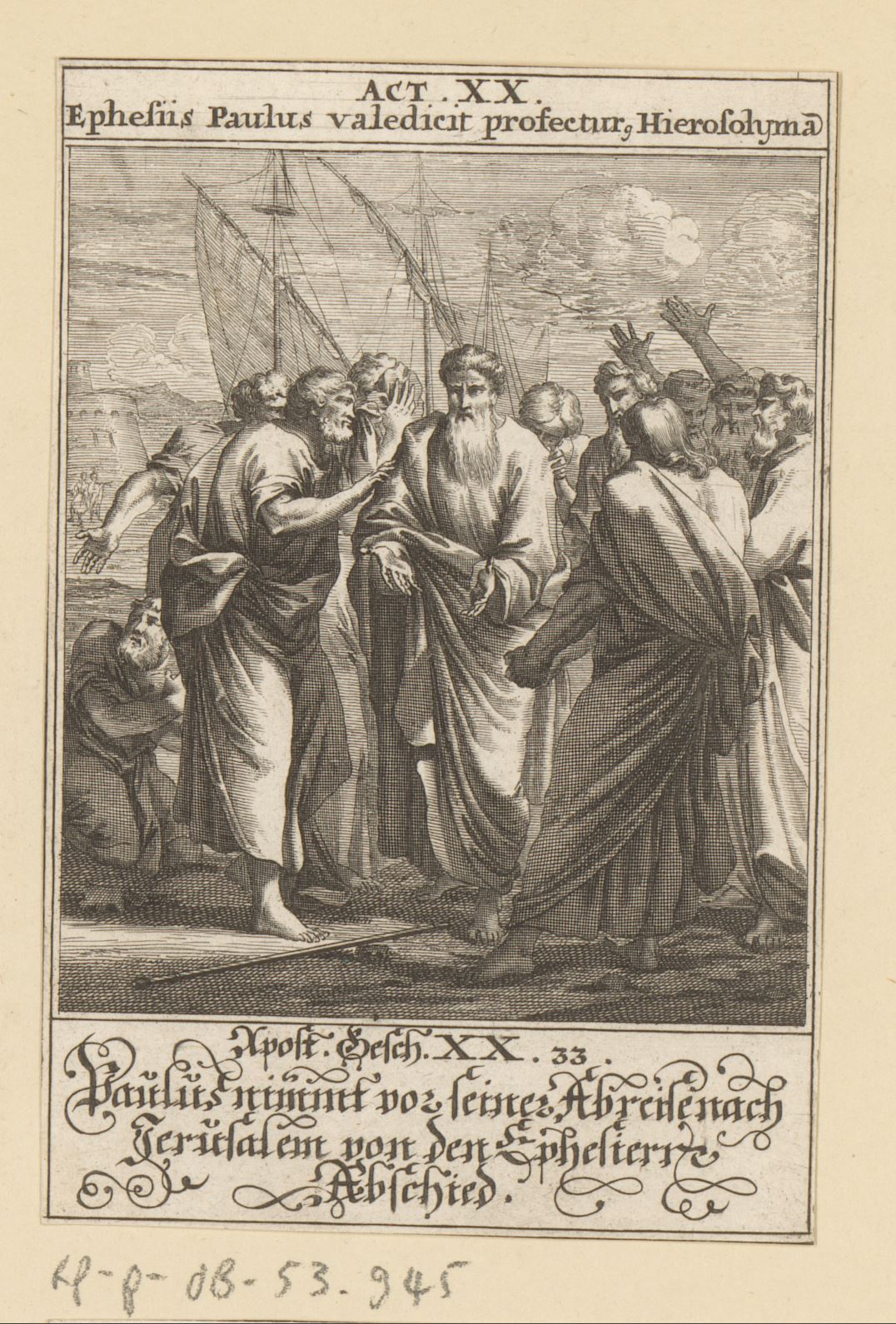
“And when he had thus spoken, he kneeled down, and prayed with them all. And they all wept sore, and fell on Paul’s neck, and kissed him, Sorrowing most of all for the words which he spake, that they should see his face no more. And they accompanied him unto the ship.”
Acts 20:36-38
“And when he had thus spoken, he kneeled down, and prayed with them all. And they all wept sore, and fell on Paul’s neck, and kissed him, sorrowing most of all for the words which he spake, that they should see his face no more.”
Ellen G. White · The Acts of the Apostles, p. 396
Notice exactly what these grown men, seasoned church leaders, grieve hardest — not the danger Paul is walking into, not their own coming responsibility without him, but simply the plain fact of never seeing his face again. Three years of shared labor, first mentioned in this study’s own previous chapter as ending in an embrace, closes here in one final, unrestrained one, on a beach, in front of the whole traveling company waiting to put back out to sea.
