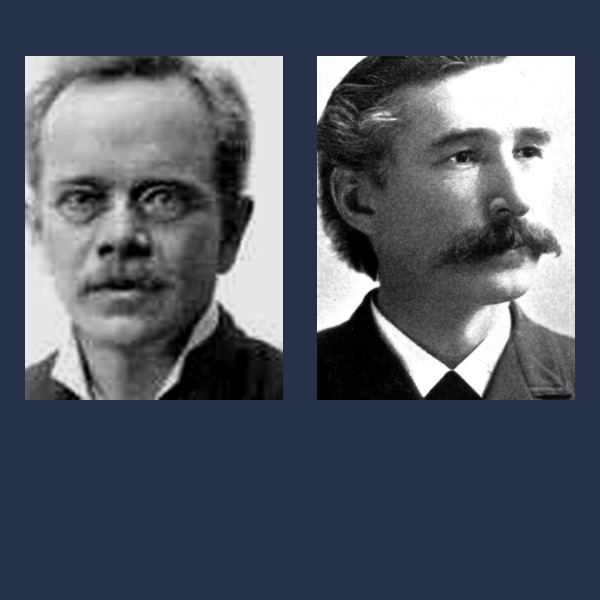
Two young editors stood up in Minneapolis and preached something the church had always claimed to believe. This is what they actually said — taken from their own books, in their own words, and not from the argument that grew up around them.
A study on Righteousness By Faith · Arthur Baldwin · StandUp4Jesus.Org · 15 min read
Table of Contents
The 1888 Message · Part 1 of 8
Alonzo T. Jones and E. J. Waggoner each presented messages related to Righteousness By Faith at the 1888 SDA General Conference Session held in Minneapolis, Minnesota.
The story of how that session went — who resisted, how far the resistance reached, and what it cost the church afterward — is told in The Rejection Of The 1888 Message. This study does something narrower and, in the long run, more useful. It sets the argument aside and asks the plain question underneath it: what did these two men actually teach?
That question deserves an answer on its own, because a great many people have an opinion about the 1888 message who have never read a page of it. It is quoted, defended, feared, and claimed — often by people describing something the two men never said. The remedy is to go to the sources.
What Survives, And What Does Not
Begin with an honest limitation, because it governs everything that follows.
There is no transcript of what was said at Minneapolis. No stenographer took down Waggoner’s studies. The General Conference proceedings for 1888 record the business of the session — committees, reports, votes on organizational matters — and not the doctrinal presentations that made the meeting famous. What we have of those days is secondhand: letters written home, diary entries, recollections set down years later by people who were in the room and who did not always agree about what they had heard.
Anyone who tells you exactly what Waggoner said on a given afternoon in that hall is reconstructing, not quoting. It is worth saying so plainly, because a claim built on a transcript that does not exist will not hold weight.
But we are not left guessing, and this is the part usually missed. Both men were working editors who published constantly, before the session and for years afterward. The message is not lost. It is in print, and much of it has never gone out of print:
- The Gospel in the Book of Galatians (Waggoner, 1888) — written as a direct reply on the disputed question and circulated at the session itself. This is the closest thing we have to the Minneapolis material in his own hand, at the time.
- Christ and His Righteousness (Waggoner, 1890) — drawn out of his Signs of the Times articles. Short, and the clearest single statement of the message.
- The Glad Tidings (Waggoner, 1900) — a full commentary on Galatians, twelve years further on.
- The Everlasting Covenant (Waggoner, 1900) — the covenants worked through from Genesis forward.
- The General Conference Bulletins of 1893 and 1895 — Jones preaching at length, taken down in full. Ironically, we have far better records of Jones five years after Minneapolis than of either man during it.
So the sources are good, with one caveat kept in view: the later books show the message as it matured, not frozen as it stood in October 1888. Where the two differ, that is worth noticing rather than smoothing over.
The Question That Started It: The Law In Galatians
The controversy did not begin over righteousness by faith. It began over a single exegetical question, and the question sounds dry until you see what hangs on it.
“Wherefore the law was our schoolmaster to bring us unto Christ, that we might be justified by faith.”
Galatians 3:24
Which law? The settled answer among Adventists for a generation had been: the ceremonial law — the sacrifices and services that pointed forward to the cross and ended at it. That reading had an obvious attraction for a commandment-keeping people. It kept Paul’s hardest sentences about being freed from the law safely away from the Ten Commandments, which the church was spending its life defending. A pamphlet setting out that position, The Law in the Book of Galatians, was circulated by the General Conference president in 1886.
Waggoner, writing in the Signs, argued that the schoolmaster is the moral law — that the law which condemns is the very law that drives a man to Christ, and that this is precisely why it was given. He did not deny the ceremonial law’s place. He denied that the ceremonial law could be the whole of what Paul meant.
But he pressed further than that, and here the familiar English is against him. He noted first that the words “to bring us” are marked in both the old version and the revised as added to the text — they are not Paul’s — and dropped them. Then he went at the word itself. The Greek word behind it is paidagogos, and Waggoner’s point is that it never meant a teacher at all. It was
“…the slave who accompanied the boys to school to see that they did not play truant. If they attempted to run away, he would bring them back, and had authority even to beat them to keep them in the way. The word has come to be used as meaning ‘schoolmaster,’ although the Greek word has not at all the idea of a schoolmaster. ‘Taskmaster’ would be better.”
E. J. Waggoner · The Glad Tidings (1900), p. 148, 149
His own preferred rendering, taken from the German and Scandinavian translations, was blunter still: master of a house of correction — in plain English, a jailer. Not a kindly tutor walking a boy toward Christ, but a warder keeping a prisoner from escaping until the ransom arrives.
Read the surrounding verses and see why he could not be dislodged. Paul has just written that “by the law is the knowledge of sin” (Romans 3:20), and in Galatians he asks whether the law is therefore against God’s promises:
“Is the law then against the promises of God? God forbid: for if there had been a law given which could have given life, verily righteousness should have been by the law. But the scripture hath concluded all under sin, that the promise by faith of Jesus Christ might be given to them that believe.”
Galatians 3:21, 22
A ceremonial system does not conclude all under sin. The moral law does. It is the commandment that stops every mouth, and a schoolmaster who cannot show you your need is no schoolmaster at all.
And that changes what the phrase under the law can possibly mean. Waggoner’s conclusion is blunt, and it is the hinge of the whole argument:
“To be under the law is identical with being under sin. We are under the law solely because we are under sin. … Those who are under the law, therefore, are the transgressors of the law. The righteous are not under it, but are walking in it.”
E. J. Waggoner · The Glad Tidings (1900), p. 148
Read that twice, because it dissolves the fear that greeted the message. To be under the law is to be in its custody as a lawbreaker. A believer released from that custody has not been released from the commandments — he has been let out of the cell and set walking in them. The law loses a prisoner and gains a keeper of it. Nobody’s Sabbath is in danger in that sentence.
Now see what was really at stake, because it was never about Galatians. If only the ceremonial law leads to Christ, then the moral law is left standing outside the gospel as a separate ground of standing with God. A believer may go to Christ for pardon and to the commandments for acceptance — and that arrangement, however sincerely held, is the oldest error there is. Waggoner’s reading shuts that door. It puts the whole law inside the gospel, doing the one work it was always able to do: driving the sinner to a Savior it cannot supply.
That is why a technical dispute about one verse would not stay technical.
First They Had To Settle Who The Savior Is
Here is the part of the 1888 message most often left out, and it may be the most important thing in it.
Waggoner understood that you cannot preach the righteousness of God given to men until you have established that the One giving it is God. So Christ and His Righteousness does not open with justification. It opens with Christ — His nature, His pre-existence, His right to be worshiped — and only then turns to what He gives.
This was not a safe move. A good many Adventist leaders of that era held views of Christ that fell short of full divinity, inherited from the movement’s Christian Connexion roots. Waggoner pressed hard in the other direction: Christ is God by nature and not by appointment, equal with the Father, the Creator of all things, and rightly worshiped.
“In the beginning was the Word, and the Word was with God, and the Word was God. … All things were made by him; and without him was not any thing made that was made.”
John 1:1, 3
Be accurate about how far he went. Waggoner still used the language of Christ being begotten, and he did not arrive at the formulation the church would adopt decades later. His position was a long step toward it and not identical with it. Saying so costs nothing and keeps the record straight.
But the logic he set in motion is unanswerable, and it is the reason this section belongs in a study on righteousness by faith at all. A Savior who is less than God has no divine righteousness to give. If Christ is a created being, however exalted, then what He offers is a creature’s obedience, and a creature’s obedience cannot cover a sinner. The whole message stands or falls on who He is. Waggoner saw that, and started there.
He also insisted on the other half — that this One took our nature in earnest, and came “in the likeness of sinful flesh” (Romans 8:3) to meet sin where it actually lives. Divinity that never came close enough to touch us saves nobody either.
Righteousness Is A Person, Not A Transaction
With that settled, the central claim of the message can be stated, and it is startlingly simple.
The righteousness God requires is not a quality He hands over at a distance, like a certificate. It is not a legal fiction in which God agrees to regard as clean what is still dirty. And it is certainly not a stock of good conduct the believer accumulates. The righteousness of God is Christ Himself, given to and living in the one who believes.
“But of him are ye in Christ Jesus, who of God is made unto us wisdom, and righteousness, and sanctification, and redemption.”
1 Corinthians 1:30
Notice the grammar. Christ is not said to provide righteousness; He is made unto us righteousness. The gift and the Giver are the same. This is why Waggoner could hold together two things that are usually torn apart — the sinner declared righteous, and the sinner actually made new — without collapsing either into the other. Both are true for the same reason: Christ has come to live in that person.
“I am crucified with Christ: nevertheless I live; yet not I, but Christ liveth in me: and the life which I now live in the flesh I live by the faith of the Son of God, who loved me, and gave himself for me.”
Galatians 2:20
Two consequences follow, and they are worth sitting with.
Assurance stops being presumption. If righteousness is a person and that person has been received, then a believer may know where he stands — not by measuring his performance, which will always give an unstable reading, but by looking at Christ. For a people trained to examine themselves closely, this landed as relief.
Obedience changes category. It is no longer the payment offered for acceptance. It is what the indwelling Christ produces in a life He has entered. The fruit does not make the tree. The old name for this is faith and works, and the two were never rivals — one is root, the other is fruit, and no one has to choose.
Faith Does Not Lower The Law
The fear running underneath the resistance was reasonable, and it should be stated fairly rather than mocked. A church that had staked everything on the perpetuity of God’s law heard young men preaching that the law cannot justify, and worried that the commandments were being quietly demoted. Men who had given their lives to defending the Sabbath were not being foolish when they listened carefully for that.
Paul had already anticipated the question, and answered it in five words.
“Do we then make void the law through faith? God forbid: yea, we establish the law.”
Romans 3:31
The message did not lower the law’s claim by one degree. It raised it. A law that could be satisfied by human effort would be a small law; the reason no flesh is justified by it is that its demand is perfect and unyielding. Righteousness by faith is not the announcement that the standard has been relaxed. It is the announcement that the standard is met — in Christ, and then in the believer by His life.
“That the righteousness of the law might be fulfilled in us, who walk not after the flesh, but after the Spirit.”
Romans 8:4
Fulfilled in us. Not waived, not lowered, not transferred to an account we never see. Fulfilled — in the actual life of an actual believer, by an actual indwelling Christ. That is a higher view of the commandments than the one it replaced, not a lower one, and it is the answer to the anxiety that greeted it.
The Two Covenants Are Two Promises
One further piece of Waggoner’s teaching deserves its own place, because it is distinctive and because it is so often missed.
The two covenants, he taught, are not two eras. They are not the Old Testament and the New Testament, and they are not law versus grace. They are two promises — and the difference is entirely a matter of who does the promising.
The old covenant is the people’s promise, made at Sinai in perfect sincerity:
“And all the people answered together, and said, All that the LORD hath spoken we will do.”
Exodus 19:8
There was nothing wrong with what they promised. The fault was in who was promising. The new covenant is built on promises God makes and God keeps — the law written on the heart by the One who wrote it on stone.
This reading has an edge to it that is easy to miss: a person can be living under the old covenant today. Anyone who answers God’s requirement with a resolution of his own — all that the Lord has spoken, I will do — has stepped back to Sinai, whatever century he lives in and however sound his doctrine is. That is not a historical observation. It is a diagnosis, and it is meant to be used on oneself.
The Everlasting Gospel And The Third Angel
Jones’s distinctive contribution shows most clearly in the years after Minneapolis, and his 1893 sermons were taken down word for word. His burden was to answer a question the church was asking out loud: is this gospel preaching the same thing as our message, or is it a different subject we are now spending time on?
His answer was that they are one message, and Revelation 14 says so on its face. The chapter that Adventists had built their identity on opens like this:
“And I saw another angel fly in the midst of heaven, having the everlasting gospel to preach unto them that dwell on the earth, and to every nation, and kindred, and tongue, and people.”
Revelation 14:6
The three angels’ messages are not an appendix bolted onto the gospel. The everlasting gospel is the content the angels are carrying. And the chapter closes by naming the people it produces:
“Here is the patience of the saints: here are they that keep the commandments of God, and the faith of Jesus.”
Revelation 14:12
Both halves, in one verse, describing one people. The commandments of God — which the church had preached for forty years and preached well. And the faith of Jesus — which is what Jones and Waggoner had come to say was missing, not as an accusation but as an observation about a message that had been carried faithfully with a piece of itself not yet unwrapped.
That is the claim in its strongest form. Righteousness by faith is not an addition to the Advent message. It is the part of the Advent message that makes the rest of it good news, and a church can hold the commandments with great courage and still be poor without it. The letter to Laodicea says as much to a people who thought they had need of nothing — it is studied in full in Behold, I Stand At The Door.
What To Do With It Now
Two cautions, and then the point.
Neither man finished well. Jones’s credentials were withdrawn in 1907 and he was disfellowshipped in 1909; Waggoner’s connection with the church ended in the same period, and he died in 1916. That history is real and it is not hidden here. But a message is not verified by its messengers, and it is not unmade by them either. What was preached at Minneapolis was Paul’s before it was theirs. Solomon’s end does not unmake Proverbs.
Do not let anyone hand you the message secondhand — including this page. The books listed at the top are short, they are in print, and most of them are freely available. Christ and His Righteousness can be read in an evening. Anyone who wants to know what the 1888 message says is roughly one evening away from finding out, which makes secondhand opinions about it hard to excuse.
And the point. The value of this study is not that it settles an old argument about a meeting in Minnesota. It is that every question those two men raised is a question a believer can put to himself tonight:
- Is the law driving me to Christ, or am I using it as a second place to stand?
- Is the righteousness I am counting on a Person who lives in me, or a record I am maintaining?
- Which covenant am I actually in — God’s promise, or my own?
- Do I have the commandments of God and the faith of Jesus, or only the half I find easier to defend?
Those questions do not require a General Conference session to answer. They only require honesty, and Someone who is already standing at the door.
The 1888 Message · Part 1 of 8
All 8 parts
Next: The Law In Galatians — the dispute that started it, at full strength on both sides →