Chapter 9 ended with Paul disciplining his own body like an athlete in training. Chapter 10 explains exactly why that discipline matters, using Israel’s own wilderness generation as the warning: baptized, fed, and given drink by miracle, and still overthrown in the wilderness through idolatry, fornication, and complaint. The very privileges Corinth now enjoys — the Lord’s own table, spiritual food and drink of their own — are no guarantee against the same fall, unless they actually flee the idolatry Israel did not.
A study in 1 Corinthians 10 · Arthur Baldwin · StandUp4Jesus.Org · 18 min read
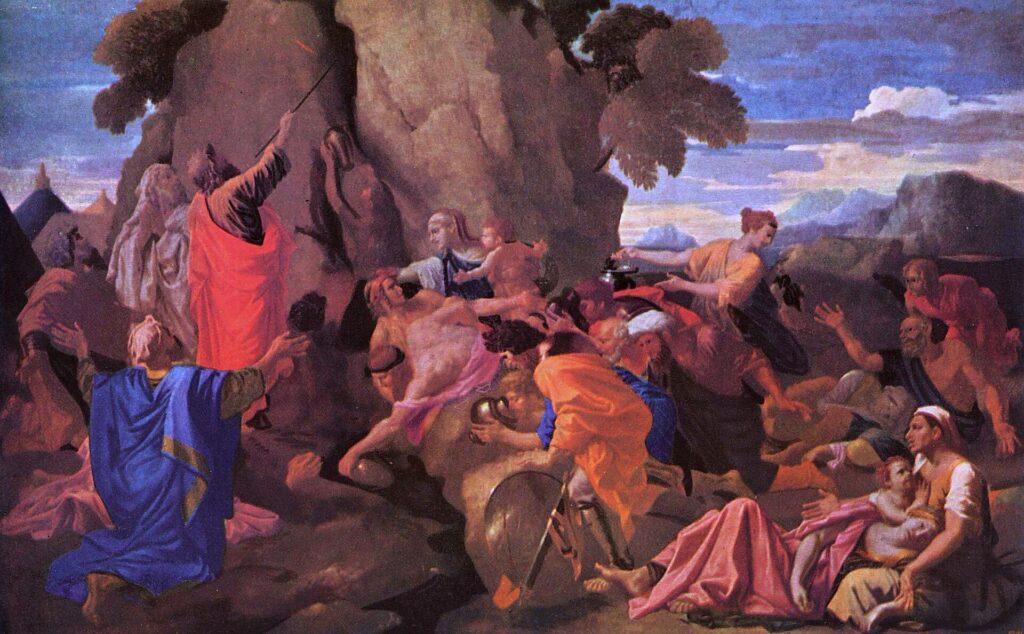
That Rock Was Christ
“Moreover, brethren, I would not that ye should be ignorant, how that all our fathers were under the cloud, and all passed through the sea; And were all baptized unto Moses in the cloud and in the sea; And did all eat the same spiritual meat.”
1 Corinthians 10:1-3
“All” appears four times in these opening verses — every single Israelite shared the same cloud, the same sea, the same miraculous food. Paul is setting up a deliberate contrast: universal privilege did not translate into universal faithfulness, and the Corinthians should not assume their own spiritual privileges will automatically do so either.
“And did all drink the same spiritual drink: for they drank of that spiritual Rock that followed them: and that Rock was Christ.”
1 Corinthians 10:4
“It was Christ, by the power of His word, that caused the refreshing stream to flow for Israel. ‘They drank of that spiritual Rock that followed them: and that Rock was Christ.’ … He was the source of all temporal as well as spiritual blessings.”
Ellen G. White · Patriarchs and Prophets, p. 411
“That Rock was Christ” is one of the boldest identifications in the whole New Testament — the literal rock Moses struck in the wilderness, centuries before Bethlehem, was already, in some real sense, Christ Himself supplying His people’s needs. This study’s own source draws out the typology further: the smitten rock, struck once and never again, foreshadows the Saviour “once offered,” a single sacrifice never to be repeated.
“But with many of them God was not well pleased: for they were overthrown in the wilderness. Now these things were our examples, to the intent we should not lust after evil things, as they also lusted.”
1 Corinthians 10:5-6
“But with many of them God was not well pleased: for they were overthrown in the wilderness. Now these things were our examples, to the intent we should not lust after evil things, as they also lusted. Neither be ye idolaters, as were some of them; as it is written, The people sat down to eat and drink, and rose up to play. … Now all these things happened unto them for ensamples: and they are written for our admonition, upon whom the ends of the world are come. Wherefore let him that thinketh he standeth take heed lest he fall.”
Ellen G. White · Counsels on Health, p. 567
This study’s own source applies verse 6 with real force to a professing people rather than an obviously pagan one — the ancient Israelites’ fall was not despite their special covenant with God but, in a sense, made worse by it. Standing on “the elevated platform of eternal truth” does not exempt a people from the same lusts that destroyed a whole wilderness generation; if anything, the source warns, it raises the stakes of the same sin.
“Neither let us commit fornication, as some of them committed, and fell in one day three and twenty thousand. Neither let us tempt Christ, as some of them also tempted, and were destroyed of serpents. Neither murmur ye, as some of them also murmured, and were destroyed of the destroyer.”
1 Corinthians 10:8-10
Four separate incidents from Israel’s own history — idolatry at Sinai, fornication at Baal-peor, testing at the fiery serpents, and murmuring against Moses — are compressed into three verses, each one a specific historical event the Corinthians would have known well from the Scriptures Paul had already taught them.
“Now all these things happened unto them for ensamples: and they are written for our admonition, upon whom the ends of the world are come. Wherefore let him that thinketh he standeth take heed lest he fall.”
1 Corinthians 10:11-12
“Let him that thinketh he standeth take heed lest he fall” is aimed precisely at spiritual confidence, not spiritual doubt. It is the person already convinced of their own stability — not the anxious, self-doubting believer — who this verse warns is nearest the fall.
A Way To Escape
“There hath no temptation taken you but such as is common to man: but God is faithful, who will not suffer you to be tempted above that ye are able; but will with the temptation also make a way to escape, that ye may be able to bear it.”
1 Corinthians 10:13
“If we commit ourselves to God we have the assurance, He ‘will not suffer you to be tempted above that ye are able; but will with the temptation also make a way to escape, that ye may be able to bear it.’ … The only safeguard against evil is the indwelling of Christ in the heart through faith in His righteousness.”
Ellen G. White · Thoughts From the Mount of Blessing, p. 118
Right after four verses of sobering warning comes one of the most quoted promises in the New Testament, and the placement is deliberate. The warning is real, but so is the promise standing directly beside it — no temptation is unique or unbearable, and God’s own faithfulness, not the believer’s own willpower, is what guarantees a way through it.
The Cup Of The Lord, And The Cup Of Devils
“Wherefore, my dearly beloved, flee from idolatry. I speak as to wise men; judge ye what I say. The cup of blessing which we bless, is it not the communion of the blood of Christ? The bread which we break, is it not the communion of the body of Christ? For we being many are one bread, and one body: for we are all partakers of that one bread.”
1 Corinthians 10:14-17
“Flee” repeats the exact instruction chapter 6 already gave about sexual sin — not reasoned resistance, but immediate departure. Paul then explains why the Lord’s Supper carries such weight against idolatry: sharing the one bread makes many believers genuinely one body, a real spiritual union no casual participation in a rival table could ever be treated as harmless alongside.
“But I say, that the things which the Gentiles sacrifice, they sacrifice to devils, and not to God: and I would not that ye should have fellowship with devils.”
1 Corinthians 10:20
“Modern spiritualism and the forms of ancient witchcraft and idol worship — all having communion with the dead as their vital principle — are founded upon that first lie by which Satan beguiled Eve in Eden. … The apostle Paul, in warning his brethren against participating, in any manner, in the idolatry of their heathen neighbors, says, ‘The things which the Gentiles sacrifice, they sacrifice to devils, and not to God, and I would not that ye should have fellowship with devils.’”
Ellen G. White · Patriarchs and Prophets, p. 685
Verse 20 flatly rejects the idea that idol worship is merely a harmless human error — behind the statue, this study’s own source argues, are real evil spirits accepting the worship humans mistakenly aim at dead wood and stone. The same source draws a direct line from Corinth’s pagan temples all the way forward to modern spiritualism, both resting on the identical lie Satan first told in Eden.
“Ye cannot drink the cup of the Lord, and the cup of devils: ye cannot be partakers of the Lord’s table, and of the table of devils.”
1 Corinthians 10:21
“Ye cannot” states an impossibility, not merely an inadvisability — the two tables are mutually exclusive by their very nature, not simply by church rule. A person may attempt to participate in both, but genuine, simultaneous communion with each is a contradiction Paul says cannot actually be achieved.
Do All To The Glory Of God
“All things are lawful for me, but all things are not expedient: all things are lawful for me, but all things edify not. Let no man seek his own, but every man another’s wealth.”
1 Corinthians 10:23-24
The exact slogan from chapter 6 — “all things are lawful” — resurfaces here with the same two-part qualifier applied to the meat question one more time. Legal is not the same as beneficial, and Paul’s practical rule of thumb, “seek… another’s wealth,” gives the Corinthians a simple test to apply whenever the theology alone leaves the answer unclear.
“Whatsoever is sold in the shambles, that eat, asking no question for conscience sake: For the earth is the Lord’s, and the fulness thereof.”
1 Corinthians 10:25-26
Paul’s practical answer turns out to be simpler than the whole theological debate might have suggested: in the ordinary meat market, do not even investigate the meat’s history, because the earth and everything in it already belongs to the Lord regardless of which altar it may have briefly passed near.
“But if any man say unto you, This is offered in sacrifice unto idols, eat not for his sake that shewed it, and for conscience sake: for the earth is the Lord’s, and the fulness thereof: Conscience, I say, not thine own, but of the other: for why is my liberty judged of another man’s conscience?”
1 Corinthians 10:28-29
The moment someone actually points out the meat’s origin, the calculation changes entirely — not because the meat itself became different, but because eating it in front of that specific person would now communicate something false about idols mattering. Paul’s own liberty is real, but he treats a brother’s informed conscience as worth more than defending his personal right to eat whatever he pleases.
“Whether therefore ye eat, or drink, or whatsoever ye do, do all to the glory of God.”
1 Corinthians 10:31
“As God’s messengers, shall we not say to the people, ‘Whether therefore ye eat, or drink, or whatsoever ye do, do all to the glory of God’?”
Ellen G. White · Counsels on Health, p. 133
This single verse turns out to be the real answer this study’s own source returns to again and again across an entire body of writing on health, diet, and daily conduct — not a narrow rule about meat offered to idols at all, but the broadest possible governing principle, wide enough to cover literally every ordinary act a believer performs.
“Give none offence, neither to the Jews, nor to the Gentiles, nor to the church of God: Even as I please all men in all things, not seeking mine own profit, but the profit of many, that they may be saved.”
1 Corinthians 10:32-33
The chapter’s closing verse gives Paul’s own summary of everything the last three chapters have been arguing, condensed into a single motive: not personal profit, but the salvation of as many as possible. Every concession Paul has made about meat, every right he refused to claim, every accommodation to Jew, Gentile, and weak conscience alike, traces back to this one unchanging aim.